
Trace Perry County's Previous Owners
Start with the deed reference on today's CAMA parcel card. Move backward one transfer at a time from there. Every row should capture the date, grantor, and grantee. It should also record the deed type and the book-page or instrument citation. Names alone are not enough. The legal description, acreage, and subdivision anchor the chain to one tract. The prior-deed reference does too, and it keeps everything tied to the same Perry County parcel.
| Source | Years It Covers | Where Held | What It Shows |
|---|---|---|---|
| Syscon electronic index | August 26, 2008-present | Perry Probate / Syscon | Indexed grantors, grantees, dates, and instrument references |
| Courthouse deed indexes and books | Before the online cutoff | Perry Probate Office | Earlier transfers and legal descriptions |
| Recorded plats | Dates vary by book | Perry Probate Office | Subdivision, lot, and tract history |
| Historic probate and land files | Cataloged from 1821 onward | Probate, FamilySearch, Alabama Archives | Estate and earlier land-owner clues |
Syscon is the current index layer. Courthouse deed books carry the older local trail, while state land and probate collections reach earlier eras. A newspaper notice is only a lead toward one of those records, never a transfer itself.
The 2008 Perry Online Cutoff
Perry County states that Syscon coverage begins August 26, 2008 and runs to the present. Searching the index is free. Viewing or downloading images requires an account or one-time prepaid credit-card access. The county also warns that Probate software is down. So an online failure may reflect access conditions rather than a genuine break in the former-owner chain.
Paper and electronic records remain available from Perry Probate at 300 Washington Street in Marion. A copy fee is assessed. When a chain crosses the 2008 online cutoff, ask staff for the historical grantor-grantee index.
Time-depth limit. The web index starts in 2008. Earlier Perry County previous owners must be followed through deed books, courthouse indexes, microfilm, and related archives.
Perry's Older Probate and Inventory Trail
Ownership does not always move by plain sale. Estates carried plenty of Perry County land between owners. Those files leave a different paper trail. FamilySearch's catalog shows Perry orphans' records from 1821 to 1859. It also lists probate records from 1859 to 1929, plus inventories from 1823 to 1925. An index stretches from 1832 to 1975. The whole set spans 21 reels of 35mm microfilm. The originals stay at the Perry County courthouse.
An estate file can surface a will, an inventory, or a court representative. It may also give named heirs, or a sale clue. Take that back to the recorded deed or the legal description in the property records. Probate context often explains a break in the chain. The next owner of record may not fit a tidy line of purchases. For the access framework, the Alabama Archives county-records page lays out the microfilm options.
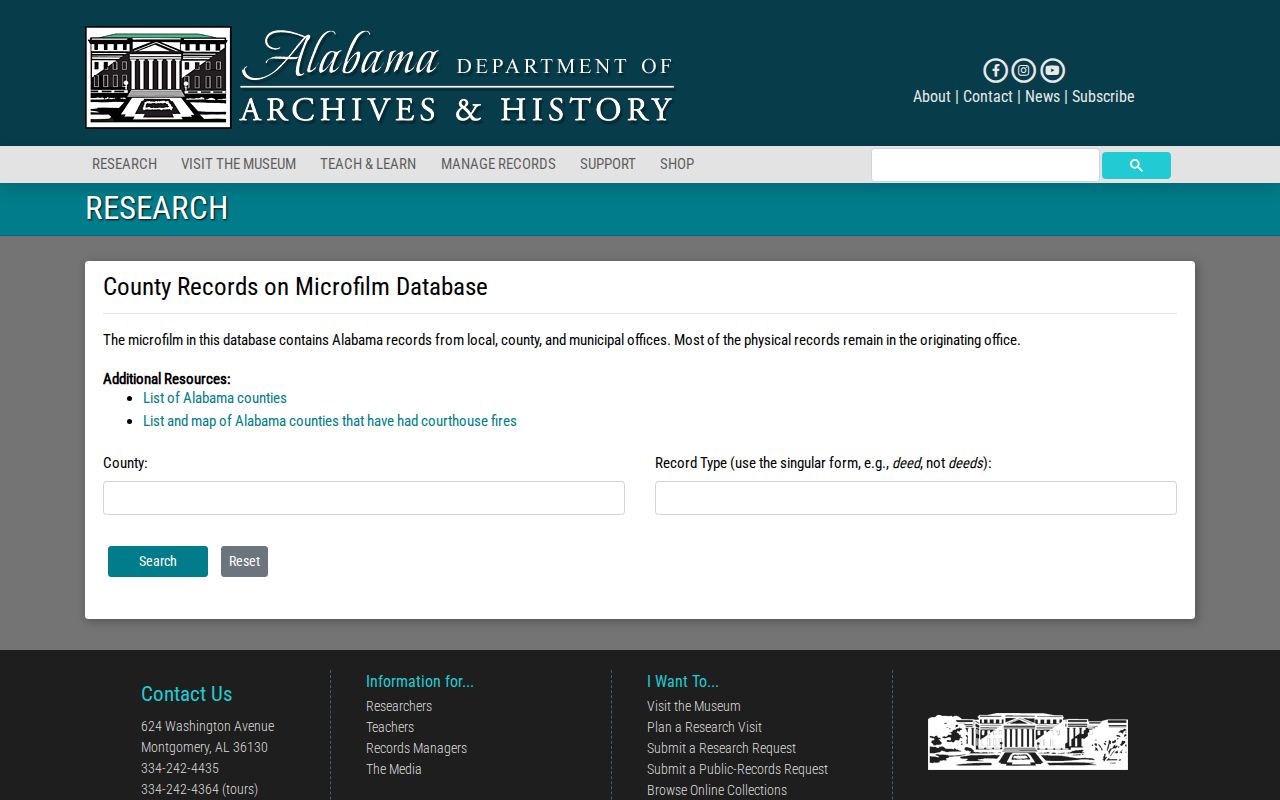
The Archives can supply a film copy or a finding aid. Most local originals, though, stay with the originating Perry County office.
State Land Records Extend Perry's Timeline
The Alabama Secretary of State land records reach from statehood through 1950. You can search them by name, township-range-section, or book. The state sends post-1950 land research to the county Probate Judge. This layer can tie an old legal description to state land activity. It cannot replace Perry County's later deed books. So treat it as one piece of the property records picture.
- Grantor
- The party conveying the described interest.
- Grantee
- The party receiving it.
- Reverse index
- A name index used to locate the deed by the receiving or conveying party.
- Chain of title
- The linked sequence of instruments for one tract.
An 1871 Perry Notice Is Only a Lead
The Marion Commonwealth shows how tax-sale and probate notices once put names into print. Each notice also carried a section-township-range description of the land. Old newspaper research rewards creativity. Search an issue by surname, plantation or road name, or by the land description itself. Terms such as executor, administrator, deed, mortgage, sale, or sheriff also pull results.
A notice is only a lead. Follow it into the courthouse deed, probate file, tax record, or court order it points toward. That second document earns its row in a prior-owner timeline. Historic advertising should never be treated, on its own, as proof of title. Title in Perry County rests on the deed records, not the advertising.
Note: Perry County carries no fire year in the state courthouse-fire list. That alone does not prove every volume survives.
Resolve Name Changes in Perry's Deed Chain
Name trouble stalls many former-owner searches in Perry County. One person can appear under initials, a married name, an estate style, or a company name in the deed records. Search every index entry in both the grantor and grantee roles. Copy each spelling exactly as the recorder wrote it. From there, compare execution date, recording date, deed type, book-page or instrument number, acreage, and the legal description. That comparison decides whether the entries describe one tract.
Not every instrument conveys land. A corrective deed may simply repair a name or description in an earlier filing. A quitclaim, mortgage release, or assignment can clear a lien without transferring ownership. Read what the deed actually does before adding anyone to the timeline.
Estate records deserve the same restraint. An executor, administrator, guardian, or conservator signs for another party without becoming the beneficial owner. Follow the probate authority through the court or estate order. That path leads to the later representative deed or the heir's conveyance in the Perry County property records.
Translate Old Perry Property Descriptions
Old Perry County deeds describe land in ways that no longer match any address. A tract may carry a section, township, and range. It may use metes and bounds, a road or plantation name, a lot and block, or a subdivision that has faded from use. Build a worksheet instead of trusting memory. List the old place name beside the current postal city and ZIP. Add the municipality, the CAMA physical address, the APN or parcel number, the land description, the deed citation, the acreage, and the subdivision.
Boundary history makes this step matter. Perry County was created in 1819. The seat moved to Marion in 1823. Later Marion and Uniontown boundary laws changed how a tract is described. No inch of dirt moved. Newbern sits in Hale County. Perryville is a community and statutory-history clue rather than a current Perry municipality.
Resist the urge to join two tracts because they share an owner or a road name. Demand continuity in the legal description or a reference to a prior deed. When acreage shifts, hunt for a split, a combination, a survey, a correction, or a partial conveyance in the deed records.
Build a Perry Previous-Owner Worksheet
Give every transfer its own line. Log the execution and recording dates apart from each other. Then list the grantor, grantee, deed type, and the book and page or instrument number. Add the legal description and stated acreage. Include the consideration if shown. Also add the citation pointing to the prior deed. A source column finishes the sheet. It notes whether the entry came from Syscon, a courthouse book, a probate file, a state land record, or a newspaper lead. That source column keeps evidence honest. A Syscon index entry points toward a record image but is not the image itself. A FamilySearch catalog listing tells you microfilm exists. It is not a transcription of the deed. A newspaper tax-sale notice hints at a proceeding without proving any deed issued. The chain will hit August 26, 2008 and keep going. Past that date, switch channels instead of stopping. Ask Perry Probate for the earlier deed index. Work through courthouse books or microfilm. Mine state land records through 1950 for clues. Open estate files whenever a death broke the sale sequence.
Perry Court Records Can Explain a Break
A title break is not always a sale. A foreclosure, quiet-title action, condemnation, judgment, or another civil order can change possession or title. It may not fit any simple pattern in the deed records. The Perry Circuit Clerk keeps the county's court records. The clerk also offers a request-for-copies form for a known or targeted case. Plan on seven working days for a search or copy request.
The fees are set out on the form. One through twenty pages costs $25, with fifty cents for each additional page. Certification adds $5. Paper history and closed or archived material carry $25 searches. Mail or deliver requests to the Perry County Clerk at 300 Washington Street in Marion. The form covers Perry County records only.
Use the court file to pull the order. It can also show the parties, the date, the property description, and any resulting deed. Then take that material back to Probate. There you can watch the order or sale enter the recorded land chain. A name on a docket alone never justifies a previous-owner row.
Walk the Perry Deed Chain Backward
Walk the chain backward from a known parcel rather than gathering every similar surname in the Perry County property records. The present deed names the prior owner who conveyed the land, and that grantor's own acquisition deed supplies the next earlier transfer.
- Copy the CAMA APN and current deed book, page, and date.
- Read the deed's grantor, grantee, legal description, and referenced prior instrument.
- Search the grantor as an earlier grantee and verify that the land description matches.
- Repeat to August 26, 2008, then continue in courthouse books and historical indexes.
- Grantor / grantee
- The transferring party and receiving party named in a deed.
- Chain of title
- The ordered sequence of recorded transfers affecting the same land.
- Legal description
- The lot, subdivision, or survey description that follows land despite address changes.
How Deep Perry Ownership Records Reach
Perry County property records reach back to 1819, when the county itself was formed. The seat moved to Marion in 1823, and the standing courthouse dates to the mid-1850s. Older ownership evidence lives in early local record books. Estate files, state land records, and newspaper files hold it too. No single index gathers all of it. The online layer of property records only covers the newest stretch of that history. Before treating two old references as the same parcel, you must reconcile shifting road names, city limits, subdivision lines, and acreage descriptions. Road names shift. City limits move. So do subdivision lines and acreage descriptions.
Lawful use. Trace previous owners for house history, estate work, and land diligence. Never use the record trail to track or harass a living person.